UMaine forest research project seeks funding support
Photosynthesis is the oldest carbon-capture technology on Earth. For eons, plants have pulled carbon dioxide from the atmosphere and locked carbon — the building block of life on our planet — into their bodies and roots.
In young forests, the widespread consensus is that this process rapidly pulls, or sequesters, carbon from the atmosphere. As forests mature, more trees start to die, releasing the carbon they captured in their wake. Carbon sequestration, the thinking goes, slowly stalls and old forests eventually release roughly as much carbon into the air as they capture.
Thirty years of measurements taken by University of Maine scientists at a remote 550-acre forest challenge this idea.
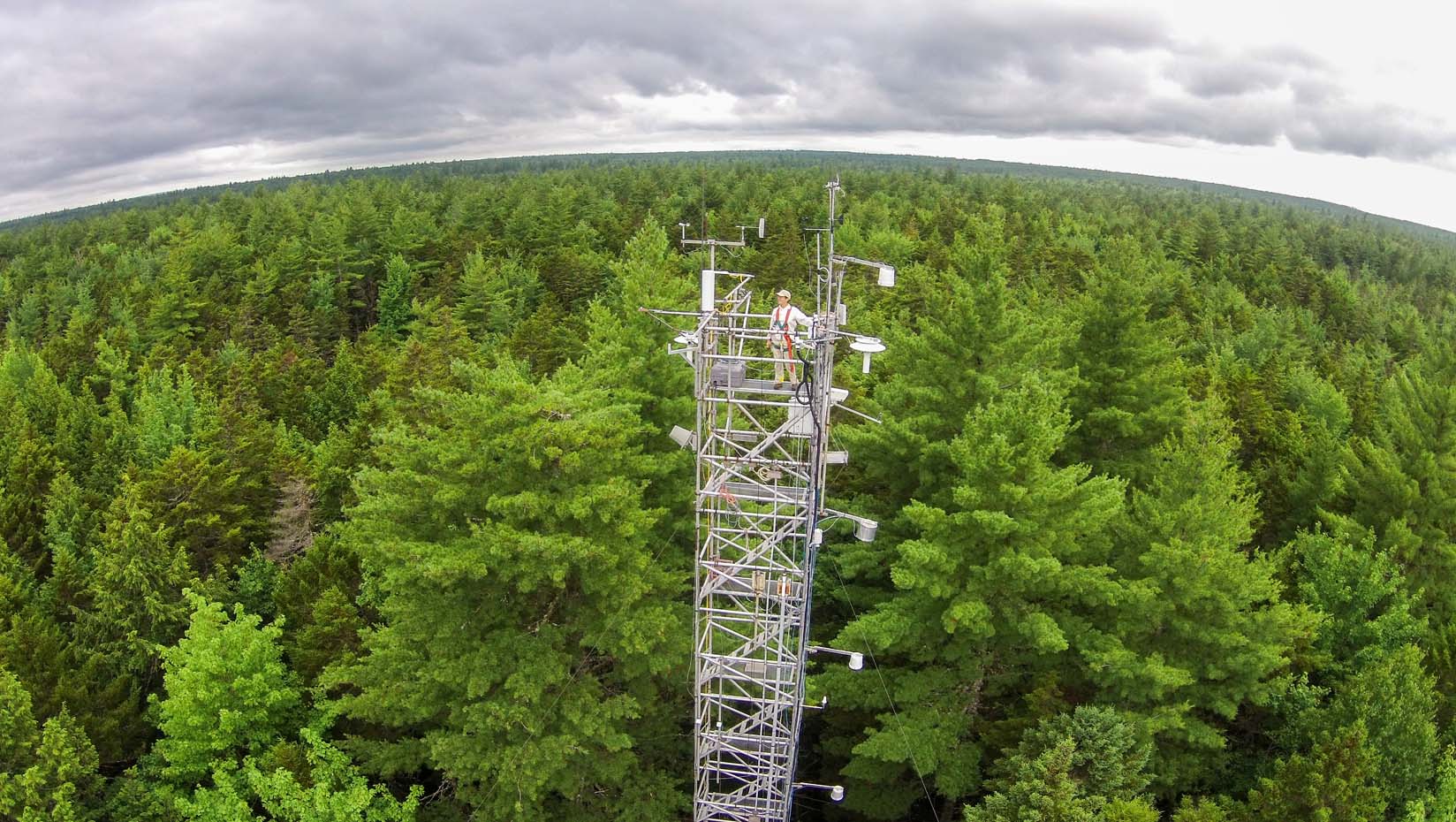
At Howland Research Forest, located about 30 miles north of Orono, Maine, in the towns of Edinburg and Howland, 98-foot towers rise above the spruce and hemlock canopy. They are topped by instruments that measure carbon dioxide flux — the exchange of the gas between the forest canopy and the atmosphere. The measurements are so precise that they can detect the breath of a technician working nearby.
What they have recorded is a carbon record of exceptional length drawn from a mature, undisturbed forest. The data generated here is reshaping how the world understands forests and their influence on climate. The towers on Howland have been collecting data since 1996, making them among the longest-running records of their kind in the United States, second only to Harvard Forest.
These findings are used by scientists, educators and land managers worldwide, informing forest management, timber production, carbon budgets, conservation and policy. But the future of this research is uncertain. For decades, the Howland towers were supported through the federally funded AmeriFlux network. As research priorities shifted, that support was interrupted, putting the long-running record at risk.
A recent $175,000 private gift to the University of Maine Foundation — equal to the site’s annual operating cost— has temporarily filled that gap, keeping the research running through next year. Without it, the towers would have gone offline this August, bringing 30 years of continuous monitoring to a standstill.
“We have funds to continue another year. But our latest research, the student experience, the experimental work on managed versus unmanaged forests — all of it depends on the towers being operational. If the tower goes offline, we lose the context this monitoring data provides, and everything that has been built on it, said associate professor of forest ecology.”
While the gift provides a one-year lifeline, it does not solve the underlying challenge. Sustaining this irreplaceable observatory and training ground for UMaine students aspiring to become foresters, conservationists and researchers requires consistent, long-term funding.
Those interested in supporting monitoring at the Howland Research Forest may donate online or contact Elizabeth Erickson, senior director of philanthropy at the University of Maine Foundation, at elizabeth.erickson@maine.edu or 207.581.1145.