First-ever named professorship at Honors College created in honor of Bernard Lown (‘42)
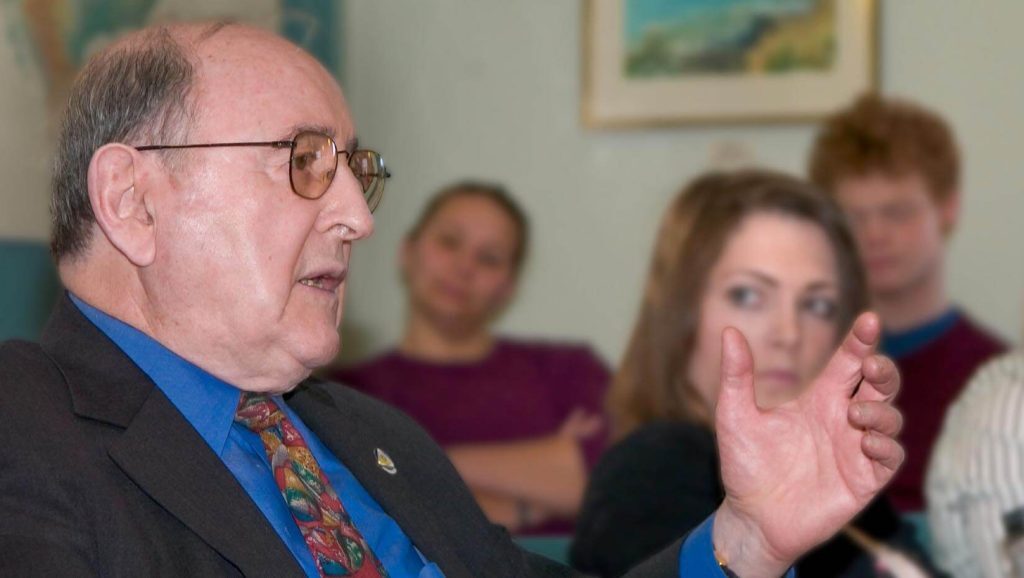
Dr. Bernard Lown speaking

A new series of courses and lectures at the University of Maine will honor the life and legacy of Dr. Bernard Lown (‘42). A devout humanitarian, Lown applied principles of peace and kindness to his work as a world-renowned cardiologist and activist for nuclear disarmament. 

Through a gift of $273,000 from Lown’s three children — Anne, Fredric and Naomi Lown, the Dr. Bernard Lown ‘42 Honors College Teaching Professorship was established at the University of Maine Foundation as the first-ever named professorship in the Honors College. This endowed fund will support a UMaine faculty member working to advance and understand societal peace, health and justice in alignment with the lifelong commitments of Bernard Lown. The fund also provides the university with resources to recognize faculty members for their innovative teaching methods and creative activities.

“From the beginning, the Honors College has been a place for students to grow their knowledge, courage and passion,” said Ellen Weinauer, dean of the Honors College. “Dr. Lown found his love of science here and began thinking deeply about the world during his time in Honors. I’m grateful that Dr. Lown’s children have recognized the impact the Honors College had on their father in this way. The professorship established in Dr. Lown’s name will have a lasting impact on UMaine students, faculty and the Honors College.”

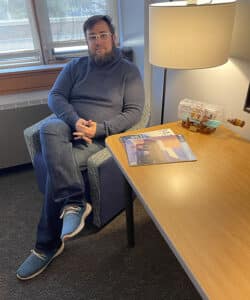
After a rigorous application and review process, Michael Haedicke, associate professor of sociology, was selected for the inaugural Dr. Bernard Lown ‘42 Honors College Teaching Professorship. 

Naomi, Fred and I were impressed with the diligence the Honors College displayed in selecting someone for this professorship,” Anne Lown said. “We were pleased that the six professors who applied were from a variety of disciplines, yet we could see the relevance to our father’s work and his values within all their fields of study.” 

An immigrant from Lithuania who moved to Lewiston in 1935, Lown invented the direct current defibrillator in 1962. Throughout his career as a cardiologist, his approach to patient care was personable and humanistic. By the end of his medical career, he had become critical of the way doctors were extending and taught to extend patient care — more procedural than personal.  

In the early ‘60s, as the threat of nuclear warfare became more prevalent during the Cold War, Lown founded Physicians for Social Responsibility. The group researched and published a paper in The New England Journal of Medicine that disproved the widely-held belief that bomb shelters could protect against nuclear war. It was one of 447 medical journal articles he authored and the beginning of work that would earn him a Nobel Peace Prize in 1985 alongside a Soviet cardiologist. 

Lown’s two-fold pursuit as a cardiologist and activist revolved around his concern for the state of the world and the issue of sudden death. He never sought fame or fortune, only to put his skill and knowledge toward the betterment of society. 

“Dr. Lown was not a sociologist, but the themes in his work and the passions that he pursued in his work are ones that connect with sociology,” Haedicke said. “Sociology is about how the choices that we make are shaped by our relationships with other people and the shared social world we live in. At the same time, sociology teaches us that we can shape that world, hopefully in positive ways.”

Haedicke’s term will begin in the fall and last through spring 2027. His first course as part of this professorship will begin in spring 2026 and is called “Making Care Public.” Students will explore meanings and practices of care in this diverse and social world, while also learning how to communicate their viewpoints. Class discussions will include topics such as the intricacies of caring for loved ones while balancing careers and empathizing with people who lack access to care.

“I applaud Professor Haedicke for designing a course that engages students in exploring how Dr. Lown used his passion for science to serve others,” said Joan Ferrini-Mundy, president of the University of Maine and its regional campus, the University of Maine at Machias. “His instruction will cultivate students’ scholarly inquiry, analytical reasoning and ability to synthesize complex ideas — capacities essential for advancing knowledge and addressing today’s most pressing challenges. I am grateful to Anne, Naomi and Fred for creating this professorship to honor their father’s remarkable legacy.”

“Making Care Public” is one of the Honors College’s Calderwood Seminar offerings. Like other Calderwood Seminars, the class will help students develop public writing and editing skills — while also exploring their own ideas, beliefs and values. Students will split into two groups and alternate between writing and editing the other group’s work. Ideally, by the end of the course, students will be able to present academic ideas, observations and data-based opinions to inform or persuade the public.

Karyn Sporer, an associate professor of sociology and faculty chair of UMaine’s Department of Sociology and Criminal Justice, said Haedicke has centered his classroom around his students and been a mentor to them since he joined their department in 2020. “He brings a rare combination of humility, insight and generosity to everything he does, and we are incredibly fortunate to have him as a colleague,” Sporer added. 

In the final semester of his endowment, spring 2027, Haedicke will deliver the first Bernard Lown Memorial Lecture, which will be open to the public.

Michael Haedicke portrait

Utilizing the Flexible Endowment Program at the University of Maine Foundation to Create a Family Legacy that Celebrates Education and Travel with Multiple Scholarships Honoring Admirable Women

Steve and Gail

Steve Norton and Abigail Daley

When Doris “Dot” Berry Norton died in 1995, her four children—Steve Norton (a member of the UMaine faculty since 1968), Abigail Norton Daley, David Norton, and Robert Norton—wanted to do something special to honor her memory.  Dot had graduated from Radcliffe College with a bachelor’s degree in French. She strongly believed in the transformative power of education and travel. She spent a post-Radcliffe year studying at the Sorbonne University in Paris. She encouraged and provided all her children with the opportunity for post-secondary education on a 4th-grade, newly minted teacher’s salary as a single parent.

Her children concluded that creating a named, permanently endowed scholarship fund that would enable students to study abroad would be the perfect legacy for her. Having decided that, they approached Dot’s alma mater about possibly establishing a fund there. They were told that creating such a named fund would require a minimum of $250,000, which was considerably more than the family had set aside. They next approached Princeton University where Steve completed his undergraduate degree, and were again told the minimum required would be in six figures. Despite pooling their resources, the minimum required by these Ivy League institutions was too high for the family to manage.

The Doris Berry Norton Travel Scholarship Fund

Determined to find a way to honor his mother’s memory, Anne Norton (Steve’s wife Annie (Peer), UMaine Class of 1958, with an MAT in French, 1970) and Steve approached the UMaine Department of Foreign Languages, chaired by Professor William Small. Small visited with the siblings and their spouses; he recommended working with the University of Maine Foundation. Steve learned that it would be possible to create a named, endowed travel scholarship in his mother’s memory for a minimum of $10,000, which could be paid over a period of several years. The family leaped at the opportunity and, in 1996, created the Doris Berry Norton Travel Scholarship Fund. This fund is now sufficiently endowed to enable UMaine students to travel to and from any University abroad for one or two semesters in a country where English is not the first language. If the University of Maine Foundation had been less flexible, what followed would likely not have occurred.

The Paula E. Peer Scholarship

Paula Peer, Anne’s mother, was born in Yorkshire, England, during World War I, lived in Belgium until 1938, and emigrated to the United States from Antwerp, Belgium, with her family in 1938. After the family’s immigration to the U. S., Anne’s family eventually settled in Blue Hill, Maine. Because Paula’s husband served in the Agency for International Development (AID) and the International Monetary Fund (IMF), she traveled to and lived in many countries. Through this travel, Paula had the opportunity to become immersed in different cultures and became fluent in five languages. She was also an accomplished artist and earned a Bachelor of Fine Arts degree from the University of the Americas in Mexico City, Mexico. Paula’s extensive travels gave her the opportunity to expand her studies to many different art forms. She also loved classical music and the performing arts. 

To celebrate, Paula, Anne, and Steve created the Paula E. Peer Scholarship fund in 1998. This fund supports UMaine students studying art and music in countries where English is not the first language. For nearly a decade until her death in 2014, Paula enjoyed how much the scholarships named in her honor helped their recipients. She was pleased to be honored. The fund will continue to help UMaine students for generations to come and is a wonderful tribute to Paula.     

The Henriette C. Murphy Scholarship

Paula Peer, Anne, and Steve decided to endow a third scholarship at the University of Maine Foundation when Anne’s favorite aunt, Henriette (Rita) Murphy, died in 2008. Rita lived in Antwerp, Belgium, where Anne was born, and spent her life caring for children with M.S.  She commonly would take a group of children to the Brugge coast for a week or more at her own expense. The Henriette C. Murphy Scholarship, which has focused on UMaine students with disabilities, became a reality in 2008. Rita lived long enough to see the new building she endowed in Antwerp that housed M.S.-afflicted children and their parents. Amy Sturgeon, Assistant Director of Student Accessibility Services, recently expressed her gratitude for her program, saying:

“Since 2008, the Henriette C. Murphy Scholarship has greatly impacted students with disabilities attending the University of Maine. The scholarships have allowed many students to achieve their educational goals that would have otherwise been impacted by financial and other barriers.”

The Annie (P.) Norton Memorial Scholarship
Anne Norton taught French and Spanish for more than 25 years at Bucksport High School and Hampden Academy and traveled abroad every year with her students to Spain, France, or the French possessions St. Pierre and Miquélon.  She believed that immersion in other cultures was critical to understanding ourselves and others.  Sadly, Anne passed away in 2009, just a year after Henriette. Over the course of her lifetime, Anne mastered French (her father spoke only English to her in Belgium, knowing the family would emigrate to America when she was two years old), Spanish, German, and Norwegian.  Steve and Anne’s three children (David Thurlow, Lisa Hydrick, and Stephen Norton) endowed the Annie (P.) Norton Memorial Scholarship fund at the University of Maine Foundation in 2009 —again, a travel fund to help UMaine students studying abroad in a country where the first language is not English.

The travel scholarships established by the Norton family honor the spirit of adventure and the importance of cross-cultural immersion. These endowed scholarships are making, and will continue to make, a tremendous impact on the lives of UMaine students. The Director of the Office of International Programs, Orlina Boteva, said,

“The Norton/Peer family has been helping UMaine students study abroad for nearly 30 years.  Over the years since their inception, more than 40 students have received scholarships from the Doris Berry Norton Scholarship, the Paula Peer Scholarship, and the Annie (P.) Norton Scholarship. The scholarships are intended to cover the travel expenses for students studying abroad where English is not the first language. Students who received one of these scholarships have spent one or more semesters in Australia, Austria, Bulgaria, Chile, China, Costa Rica, Czech Republic, Germany, Italy, Japan, Jordan, South Korea, Spain, Tanzania, and Ukraine (before the war). They returned to UMaine full of memorable stories, new skills and friendships, and described their study abroad experience as transformative.”

Through the four endowed scholarship funds the family has created at the University of Maine Foundation, their legacy of kindness has changed the lives of UMaine students.

Steve Norton wrote:

“Creating these endowments that allow Maine students to advance into the world has been a very rewarding experience for my late wife Anne and me, especially when we received letters and notes from abroad or locally, acknowledging what a difference my family and I made in their lives. Bill Small would be pleased that we followed his lead. When these students are able to support other students’ aspirations, I know the University of Maine Foundation stands ready to help them advance opportunities for UMaine students from anywhere. The Foundation has always listened to what we wanted to accomplish, and we have reacted as a team toward any refined goals.”

Foundation Facilitated Gift From the Goos Family Expands UMaine’s Ceramics Curriculum

Foundation Facilitated Gift From the Goos Family Expands UMaine’s Ceramics Curriculum

Rod Sparrow Photo

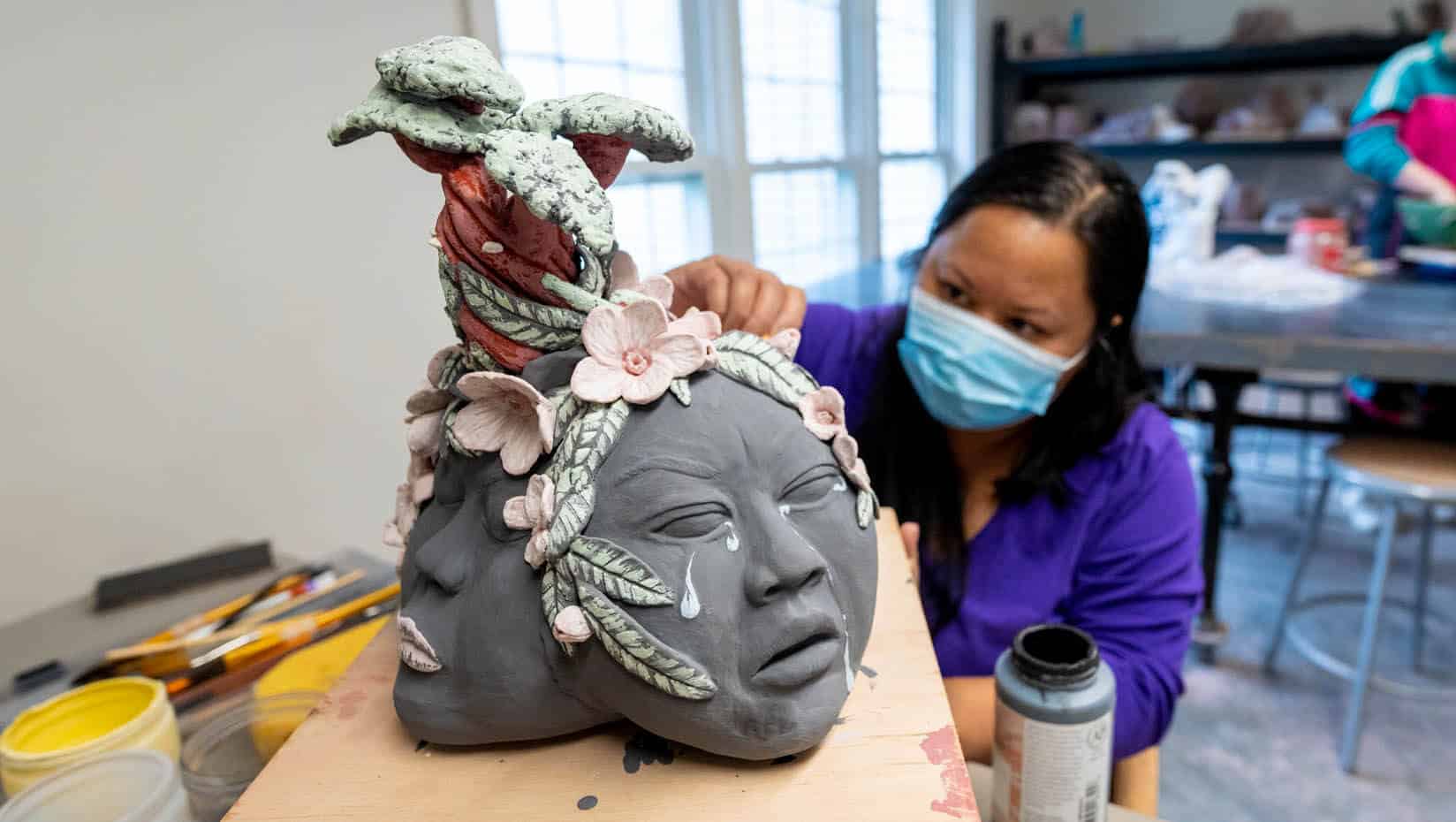
As far as art goes, ceramics are exceptionally bulky. Ceramics classes need space for clay, drying shelves, kilns and a variety of glazes. For university art programs, the equipment-heavy ceramics can often fall by the wayside, even if interest is high. 

Thanks to a generous donation from Sam and Sarah Goos, whose daughter Ariel studied studio art at UMaine and graduated in 2019, UMaine was able to open the Goos Family Studio. The new studio is allowing the ceramics program at UMaine to grow and giving plenty of space for students to be creative. Now that the program’s new class, Ceramics II, is wrapping up its first semester in the studio, students in the Department of Art and beyond are already seeing the impact of the gift and what it was able to achieve. The gift was facilitated through the University of Maine Foundation, with the aid of Philanthropy Officer Matt Mullen, who emphasized what an exceptional gift it was. To read more about the Goos donation, click here for the UMaine News article. 

None of the information on this website should be considered legal or financial advice. We encourage you to consult with your own legal counsel or financial/tax advisor before deciding whether or not to proceed with a gift or change to your estate plan.

Sharing

Libra Professorship Program Highlights

Libra Professorship Program Highlights

Rod Sparrow Photo

Since established in 1989, the ten Libra Professorships at the University of Maine have been transformational in attracting and supporting outstanding faculty. Libra Professors, among the best and brightest in their fields of study, have provided exceptional educational opportunities for thousands of UMaine students across disciplines over the last three decades. The design of the program ensures that active recruitment of new faculty is ongoing as new ideas are constantly being explored and developed at our flagship research university.

Meet two of our current Libra Professors below:

Libra Professor in Maine Business School (MBS)

Dr. Rusty Stough

Dr. Rusty Stough arrived at UMaine with a plethora of experiences. In his undergraduate career, he majored in Chemistry and Biology while also being a student-athlete on the football team. Upon graduation, he began a pharmaceutical research career. The success of his research brought him into the world of marketing, which eventually led him to pursue his Masters in Colorado, and later, his Ph.D. in Wisconsin. As he was looking for his next career move into higher education, Rusty and his wife were thrilled to find Maine as their next destination.

The Libra Foundation’s support of his position has allowed Rusty to bring his family to Maine while continuing to grow as a professional, a teacher, and as a lifelong learner. Through his professorship, Rusty has worked to create and sustain partnership programs in his classrooms that work with local employers to find out what skills they are looking for in their job candidates. Because of these programs, Dr. Stough’s students are graduating with highly sought-after skills in the business world, such as computer programming. He has also started a partnership with Penobscot Theatre Company, which spawned a mutually beneficial relationship between the theater and UMaine students. Those students gain real-world marketing experience by helping to promote some of the shows, including last season’s well-received performance of 9-5.

Stough has also offered himself as a mentor for both undergraduate and graduate students working on research projects in the business school. One of his favorite memories since being at UMaine was publishing a paper with one of his undergraduate students on the role of verification among social media and internet influencers.

 Stough has also presented his research on non-conscious attention at a few virtual conferences and hopes to travel to some in person as a UMaine representative in the coming years. The Libra Foundation has been instrumental in helping Stough make these strides here at UMaine, “we do things with eye-tracking and other EKG-type things that are expensive and it’s expensive to get participants in to recruit for our research. The Libra allows me to do that very easily.”

Stough’s students feel the benefits of this funding as they gain tangible and transmissible skills in the classroom and in their desired professional fields. This is made possible with the funding for a Teaching Assistant, giving more students one-on-one assistance and support, which makes all the difference in their educational experience.

The Libra Foundation opens the doors at UMaine for professors who make a huge impact on their student’s lives and the University community. Thanks to the Libra Foundation, UMaine has been lucky to welcome Dr. Rusty Stough as someone who represents the innovation, drive, and passion that Black Bears take pride in as we seek to define tomorrow.

Libra Professor in the College of Natural Sciences, Forestry, and Agriculture

Dr. Margaret L. Estapa

Growing up in Iowa, the coast was an unfamiliar and mysterious place to Dr. Margaret Estapa, but the Libra Foundation helped her build her dream career as a UMaine Oceanography instructor at the Darling Marine Center. Black Bear alum Meg Estapa completed her Ph.D. in the Oceanography program at UMaine with the help of her mentors, professor emeritus Dr. Larry Mayer and professor Emmanuel Boss. After graduating in 2011, Estapa worked at Skidmore College in New York until Dr. Mayer retired in 2019. Estapa applied for his position and moved back to Maine, much to the delight of her family, many of whom love Maine.

Her position is made possible with the assistance of the Libra Foundation, and Dr. Estapa has made sure the support is put to good use. Students in Estapa’s courses in the Semester-by-the-Sea program have the unique opportunity to practice repeated, hands-on scientific methods skills through the Estapa Lab.  During Semester-by-the-Sea, students are often out in the field collecting samples, operating tests in the lab, and being exposed to cutting-edge technology and methods. Access to Estapa’s facilities and technology is possible because of the generous financial support from the Libra Foundation.  Touching on her passion for field-based learning and teaching, Estapa said, “the courses that are farther from my expertise are the ones where I learn the most and the ones where I grow the most as a scientist and a teacher. The ones that are closer to my expertise, I don’t necessarily grow as much, I just have deeper conversations about things. There’s so much to like about all of them, regardless of how close they are to what I do.” Continuing from her Ph.D. work, Estapa is researching the ocean’s carbon cycle and how the ocean and marine life interact with climate change and global warming. In addition to the resources for ongoing projects, the Libra Foundation has also helped with startup costs for new projects such as Estapa’s Marine Microplastics Research program and research using remote sensing of the coastal environment through some of the satellites in orbit around the Earth.

Estapa’s lab continues to contribute to a field of research that is near and dear to Mainers and is relevant and urgent for the entire planet. Her return to UMaine is thanks to the Libra Foundation and their professorship program. Estapa’s gratitude for the Libra support extends even beyond her career, “I’m living the life I want to live for personal and professional reasons.”

None of the information on this website should be considered legal or financial advice. We encourage you to consult with your own legal counsel or financial/tax advisor before deciding whether or not to proceed with a gift or change to your estate plan.

Sharing

Foundation Member Meets Scholarship Recipients

Edie McVay and Student

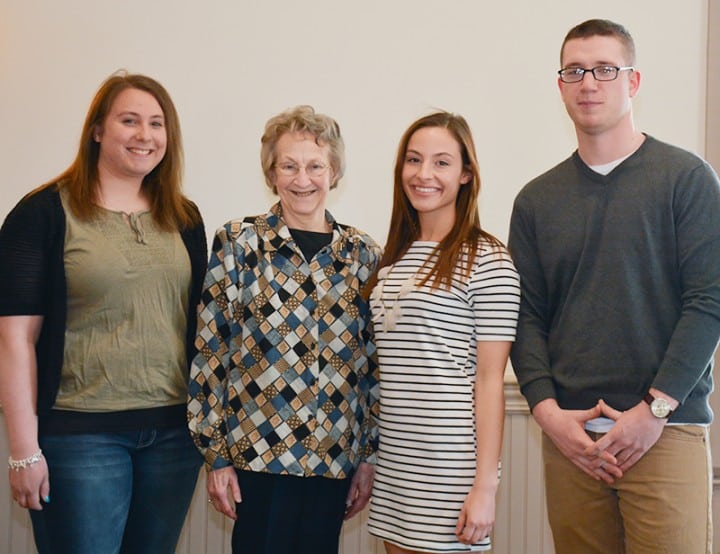
Pictured: (left-right), Laura Horowitz ’17, Edie McVay King ’67, Alexis Bowman ’16, Mason Crocker ’16

University of Maine Foundation Member Edie McVay King ’67 had the chance to meet current recipients of her Edie McVay King Scholarship at a recent scholarship reception hosted by the University of Maine Department of Molecular and Biomedical Sciences at Buchanan Alumni House.

King, who graduated from UMaine in 1967 with a degree in bacteriology, created the endowed scholarship fund specifically for students with a major in her field. Her gift is awarded annually to UMaine students, supporting new professionals in her area of expertise.

The Stephen E. King Chair in Literature Endowment Fund is Established at the University of Maine Foundation by the Alfond Foundation

Stephen King

An endowed chaired professorship in literature named in honor of best-selling author and University of Maine alumnus Stephen King will be established at his alma mater with the help of a $1 million award from the Harold Alfond Foundation.

The Stephen E. King Chair in Literature will support a faculty position in the Department of English in honor of King’s “substantial body of work and creative impact.”

The endowment for the faculty chair position, the first for the English Department, is held at the University of Maine Foundation. A search to fill the position is expected to begin this fall.

An event celebrating the King Chair is being planned for later this year.

“The Harold Alfond Foundation is delighted to make this grant in honor of Stephen King and in support of Maine’s flagship university,” said Greg Powell, chairman of the Alfond Foundation’s Board of Trustees. “This chaired professorship is a tribute to Mr. King’s outstanding literary accomplishments and his deep commitment to Maine.”

University of Maine President Susan J. Hunter called the endowed chaired professorship “an exceptional gift that honors the tremendous literary legacy of UMaine’s most well-known and beloved alumnus.”

“Stephen and Tabitha King have been generous supporters of their alma mater for many years,” said Hunter. “It is now particularly rewarding to have a prestigious gift such as this that will inspire and influence current and future generations of readers and writers.”

The endowed chaired professor will help UMaine recruit and retain a faculty member who is an accomplished teacher and a scholar of literature, according to UMaine College of Liberal Arts and Sciences Dean Emily Haddad.

“This gift from the Harold Alfond Foundation recognizes both Stephen King’s extraordinary career and the importance of literature in the public sphere. The King Chair will expand the UMaine English Department’s leading role in literature, creative writing and the humanities. Building on the recent successes of the University of Maine Humanities Center, the King Chair will continue to engage students, fellow scholars and the public in the study and appreciation of literature,” Haddad said. “King is an inspiration for students who are fascinated by literature and its contributions to human culture. The opportunity to study with the King Chair gives them one more reason to choose UMaine.”

Through the years, Harold Alfond and the Harold Alfond Foundation have made more than $19 million in gifts and pledges to the University of Maine, including naming gifts for Alfond Sports Arena and Alfond Stadium, and the creation of the annual Alfond Challenge to benefit UMaine football. Thousands of students, fans and other members of the UMaine community have benefited from the philanthropy of the Alfond Foundation and Harold Alfond, according to University of Maine Foundation President Jeffery Mills.

Last fall, the Alfond Foundation also awarded a $3.9 million gift to complete the W2 Ocean Engineering Laboratory and Advanced Manufacturing Laboratory at the Advanced Structures and Composites Center on campus. The $13.8 million facility is named in honor of the philanthropist.

Similarly, generous support for UMaine has come from the Kings and the Stephen & Tabitha King Foundation, which is devoted to promoting, strengthening and supporting Maine communities.

King is a 1970 UMaine graduate who was awarded a National Medal of Arts last September as one of the world’s best-known authors. He and his wife, author Tabitha King, also a UMaine graduate, both received honorary degrees from their alma mater in 1987. As a UMaine English major, King’s mentors included professors Burton Hatlen, Edward Holmes and Jim Bishop. Stephen King’s most recent book is the story collection “The Bazaar of Bad Dreams.”

Special Collections in UMaine’s Fogler Library holds the Stephen Edwin King Literary Papers, available by request with certain access restrictions.